
A guide to WeatherNet
When bad weather hits, you need answers fast. That’s why we use independent data from WeatherNet, to help us assess weather-related claims quickly and fairly.
What is WeatherNet?
WeatherNet1 is an award‑winning weather data service. It tracks storm, wind and rainfall across the UK and shows risk at postcode level using a simple traffic‑light system: red, amber or green.
It also includes a forecasting tool called SurgeCast. This predicts severe weather before it arrives and means we can warn our customers early to help them prepare.
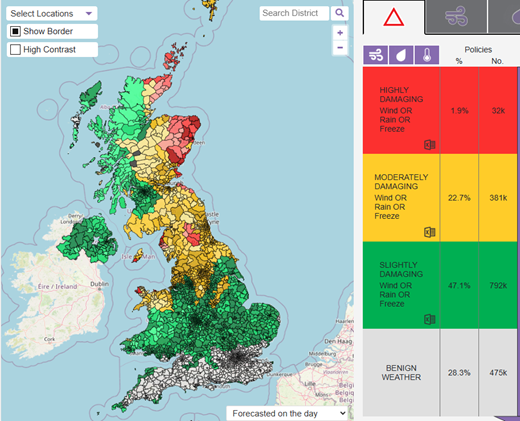
Source: example image from weathernet
How WeatherNet works
WeatherNet tracks conditions right down to your postcode. That means we don’t rely on broad weather reports that cover large areas and may miss what’s happening on your street.
Instead, it uses specialist meteorological data to understand exactly how strong the winds were, or how much rain fell where you live. That helps us assess what damage the weather could have caused to your home.
With SurgeCast, we can also see severe weather before it arrives. We were proud to be the first personal lines insurer to combine precise geographical weather data with customer postcodes – helping people get ready before bad weather strikes.2
How we use WeatherNet for claims
We know how disruptive weather damage can be. When your home is flooded or your roof is damaged, you just want things sorted.
WeatherNet helps us move faster and make fair decisions, informed by reliable data, from the very start.
How it works
-
Step one: checking the weather
Once you’ve made a claim, we use WeatherNet to confirm whether the weather meets your policy conditions.
For example, as a guide, storm conditions are typically associated with wind speeds of around 55mph or more, the minimum wind speed for a storm, according to the Beaufort Scale3 and the Association of British Insurers4 (ABI). However, this doesn’t automatically determine whether a claim will be accepted. We always assess each claim individually, considering your policy and the specific circumstances.
The wind, rain, snow or hail need to meet the following criteria:
 |
Usually, damage caused by wind speeds under 55mph isn't covered, but we know every situation is different. So even if the wind wasn't quite 55 miles per hour, we might still look at the damage. |
 |
Rainfall of more than 25mm in an hour |
 |
Snowfall of 30cm or more that falls in a 24-hour period |
 |
Hailstones that damage hard surfaces |
If conditions were close to these levels, we may still send someone out to inspect the damage.
How do I know if windspeed reached 55mph?
To help you picture what the different windspeeds look and feel like, the below gives an overview.
Estimating Wind Speeds using The Beaufort Scale5
| Force 8 - Gale (39–46mph) |
Twigs break off trees; walking becomes difficult |
| Force 9 - Strong gale (47–54mph) |
Minor structural damage, tiles or chimney pots displaced |
| Force 10 - Storm (55–63mph) |
Trees uprooted; significant structural damage |
| Force 11 - Violent storm (64–72mph) |
Widespread damage, very rare inland |
| Source:extract only, see full table5 | |
What is the Beaufort Scale?
The Beaufort Scale is a simple way to describe wind speed, based on what it looks like on land or at sea. It is also known as the Beaufort wind force scale.3
-
Step two: matching the data
Once policy conditions are confirmed, we use WeatherNet to:
- Match the weather event to your exact postcode
- Check the claim details align with the recorded conditions
If everything matches, your claim moves forward, subject to a full assessment of your policy and circumstances.
Step three: putting things right
Depending on the type of claim, the next step would usually be:
- We arrange for someone to inspect the damage
- And then, either appoint a contractor, or pay you directly to arrange repairs yourself.
How WeatherNet benefits you
Using WeatherNet means we can:
- Use independent data to assess claims efficiently
- Assess damage at postcode level, not just by area
- Make fair decisions faster – whether one street or a whole town was affected
- Be clear and transparent about how weather events are assessed
The forecasting tool, SurgeCast, also helps us prepare our claims teams in advance, so support is ready online and, on the phone, when you need it.
That’s why WeatherNet matters
It helps us respond faster, more fairly and more precisely – so you can get back to normal sooner.
Sources
2 Ageas forecasts geographical impact of weather with WeatherNet
3 Beaufort wind scale | Royal Meteorological Society
4 Preparing for Storms | ABI Preparing for Storms | ABI
5 Estimating Wind Speeds Using the Beaufort Scale| Weatherschool