
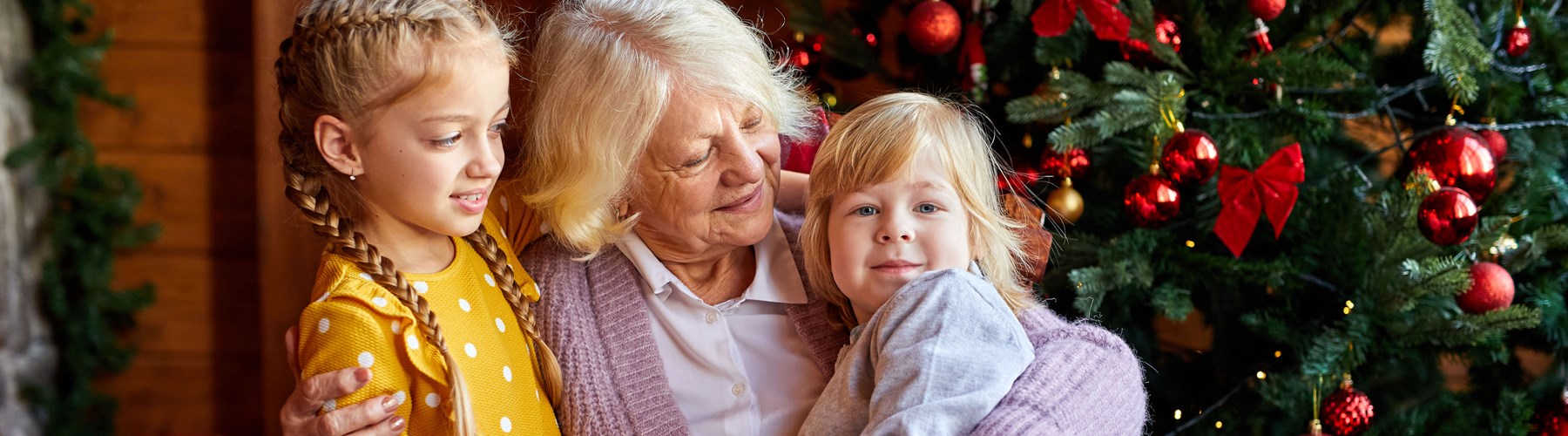
Christmas traditions - where do they come from?
UK Christmas traditions not only bring families closer together across the generations, but they also help us create cherished memories. They provide comfort and a sense of continuity, guiding us to focus on what truly matters.
From iconic customs like the Christmas tree and mince pies to the jolly Christmas cards and the exciting crackers, we explore the origins of these cherished traditions and celebrate the unique spirit of a British Christmas.
In short
One easy Christmas custom to do: hang a wreath from your front door – it’s simple, symbolic and adds instant festive charm to your home.
Must know
- Prince Albert popularised the Christmas tree
- Tom Smith invented Christmas crackers
- The first commercial Christmas card appeared in 1843
- Boxing Day began as a day for giving to servants and the poor
- Mince pies were originally savoury
- The King’s Christmas message has been a tradition since 1932
The origins of British Christmas traditions
Christmas traditions began long before Queen Victoria’s reign (1837-1901), with Encyclopaedia Britannica stating that festive customs originated from Pagan traditions, such as Yule and midwinter festivals.1 However, we owe much of our cherished UK Christmas traditions to the Victorians.
Author Charles Dickens and Prince Albert are widely credited with shaping the way we celebrate Christmas today.2 Dickens’ novella A Christmas Carol (1843) transformed the holiday from a time of drinking and rowdiness to a cheerful tradition of family gatherings, festive meals, carol singing, and charitable giving and gifts.3
Iconic UK Christmas traditions and their histories
These are some of the most common traditions and where they came from:
The Christmas tree
Christmas wouldn’t be Christmas without the tree, a Victorian custom which originated in Germany. Prince Albert, Queen Victoria’s husband, popularised the idea after a drawing of him and his family around a decorated tree appeared in the Illustrated London News in 1840.2
However, it was another German, Queen Charlotte, wife of King George III, who introduced Christmas trees to the Royal family. She ordered a yew tree to be brought to the Queen’s Lodge in Windsor in 1800 and decorated it herself.4
The tradition of a decorated tree actually started much earlier. Some credit Riga in Latvia, which has a memorial plaque commemorating its appearance in 1510, although Estonia and Lithuania disagree.5 Others say it comes from Strasbourg, where fir trees with apples as decorations were recorded in 1605.1
Christmas crackers
A sharp snap, groanworthy jokes, colourful paper hats and various knick-knacks – that’s a Christmas cracker wrapped up! But do you know who came up with the idea?
An enterprising sweet-maker and baker, Tom Smith made what would become the Christmas cracker. Inspired by twisting paper around a sugared almond and adding a love motto inside, he took out a patent on his idea in 1847. The sounds of a crackling fire led him to add a narrow explosive strip in the 1860s, according to the Victoria & Albert Museum.6
Tom later replaced the sweets with toys, and his son, Walter, added hats to crackers, which have become a Christmas must-have.
Christmas cards
Another Victorian tradition was the practice of sending Christmas cards, which began in 1843 when artist John Callcott Horsley designed the first on commission from Sir Henry Cole.7
According to the UK Greeting Card Association (GCA), Christmas cards soon caught on and experienced massive growth when the Post Office introduced the Penny Post. Their popularity continued into the 1900s, with Christmas cards adorned with both Christian and secular images, including robins, holly, ivy, snow, and Christmas trees.
Sales of Christmas cards have declined in recent years as the cost of postage and the rise of e-cards have taken hold, but they remain popular.
Mince pies
No Christmas would be complete in the UK without a mince pie (or two). They were packed with dried fruit and lamb or veal in Tudor times, according to Historic UK, but now this tasty festive treat is a sweet concoction of alcohol-soaked fruit, spices and citrus peel baked in pastry.8
We no longer add a baby Jesus to the lid or 13 ingredients to represent Him and his disciples. The Tudor tradition of pies with a coffin-shaped crust or pinched tops changed to round pies after the Reformation. The Victorians changed the savoury meat to sweet mincemeat.
Other traditions around mince pies include stirring the mixture in a clockwise direction, making a wish when you eat your first one of the year, and never cutting them with a knife.8 Nowadays, your family’s festive traditions may include adding cream, brandy butter, or custard to a hot mince pie.
The King’s Speech
The King’s Speech at Christmas has long held historical significance in the UK and homes across the world. King Charles’s great-grandfather, King George V, delivered the first Christmas broadcast by a British monarch at 3pm on Christmas Day to the UK and the Empire in 1932.9
Charles’s mother, Queen Elizabeth II, continued the Christmas tradition and made the first televised broadcast live in 1957, with her final speech seen by 8.96 million viewers. Our present King made his debut Christmas broadcast as the monarch in December 2022. It was even more popular than the Queen’s, topping the ratings with a UK audience of 10.7 million people.10
Not even Strictly Come Dancing or Michael McIntyre’s Xmas Wheel came close, with 5.44 million turning into Strictly and 4.81 million to the Xmas Wheel.
Boxing Day
Taking Boxing Day (26 December) as a holiday became a tradition after masters in Queen Victoria’s time, when the masters gave it to their servants as a rare day off. The servants would receive a special Christmas box, which they could take home to their families.11
However, some historians link it back to the second and third centuries AD, when churches began another tradition – the collection of funds through collection boxes. Churchgoers on Christmas Day would put money into the collection box, and people experiencing poverty would receive the cash on Boxing Day.
Christmas food and drink
Christmas has traditionally been a period of overindulgence since the Middle Ages, when feasts were held and merrymaking continued for 12 days.12 Rich Tudors continued the custom, celebrating with sugar banquets.
Today’s Christmas food and drink traditions began in Queen Victoria’s reign, although the custom in Victorian times was to eat goose, rather than turkey, on Christmas Day.
Contrary to what many people believe, eating turkey has nothing to do with the American tradition of Thanksgiving. Nor does it stem from Dickens’ A Christmas Carol, when Ebeneezer Scrooge sends Bob Cratchit a large turkey.
Instead, Henry VIII is said to be responsible for introducing the turkey custom, after choosing the bird over a goose for a 16th-century royal Christmas feast. It’s become a UK tradition on Boxing Day to eat any leftovers, making turkey curries well into the week!
The charm of British Christmas traditions endures, even as technology, sustainability, and inclusivity reshape how we celebrate in today’s multicultural UK. However you choose to mark the season, we wish you a joyful Christmas and a bright, happy New Year.
Sources:
- https://www.britannica.com/topic/Christmas
- https://www.history.co.uk/articles/prince-albert-and-charles-dickens-the-men-who-invented-christmas
- https://www.librarypoint.org/blogs/post/dickens-christmas/
- https://www.history.co.uk/articles/a-brief-history-of-christmas-trees
- https://www.lrt.lt/en/news-in-english/19/1302535/was-the-first-ever-christmas-tree-put-up-in-the-baltics?srsltid=AfmBOork_0oibit4HDJlIpYh3mmhAvnU1yPIXO0FeW5yes-W7RQ-KkDw
- https://www.vam.ac.uk/articles/the-christmas-cracker
- https://www.gca.cards/who-sent-the-first-christmas-card/
- https://www.historic-uk.com/CultureUK/Mince-Pies/
- https://www.royal.uk/the-christmas-broadcast
- https://www.bbc.co.uk/news/entertainment-arts-64094088
- https://www.bbc.co.uk/newsround/46454700
- https://www.english-heritage.org.uk/christmas/the-history-of-christmas/