
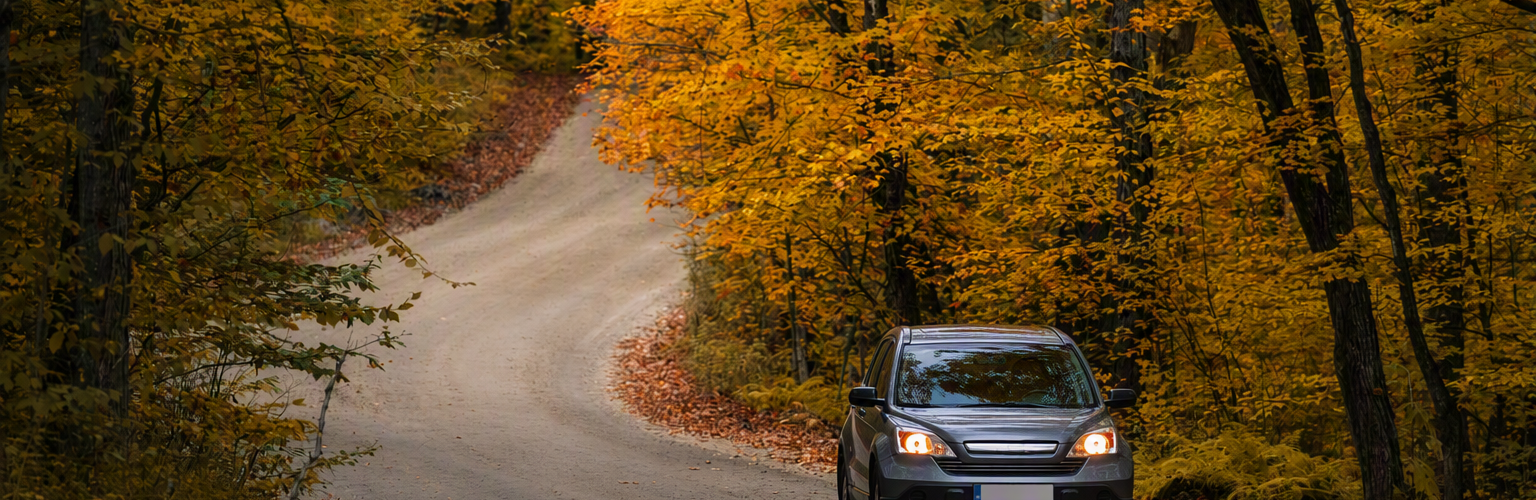
Thinking of a scenic autumn drive? Don’t leave without these essentials
A scenic autumn drive is just the ticket for seeing the UK at its prettiest, as the trees turn rich, vibrant shades of red, yellow and orange.
However, if you’re travelling in the UK this autumn, remembering a few essentials before you go will ensure a safe, enjoyable drive, whatever the weather.
Must know
Always check your tyre pressures before setting out on a scenic autumn drive, as leaves on the road can affect their grip.
In short
The main dangers of autumn driving are:
- Sun glare
- Wet leaves
- Sudden fog
- Deer and wildlife on the road
- Darker evenings
The joys of autumn driving
Autumn spans from September to November and brings cooler temperatures, longer nights and unsettled, stormy weather towards the end of the season.[3] Making the most of autumn’s joys means preparing yourself for anything the weather can throw at you.
Car safety checklist: essential vehicle checks before you go
For autumn driving, the main focus is on inspecting your tyres before you set off. Slippery roads covered in fallen leaves mean you want good tread on your tyres to grip the road. Cooler temperatures also affect your tyre pressure, so recheck it before you set off on your scenic drive.[4]
The Royal Society for the Prevention of Accidents (RoSPA) also recommends cleaning your windscreen and checking your lights. If you have an electric car, make sure it’s fully charged. If you have a petrol or diesel car, get your battery checked before you go.
Don’t forget to pack a torch, an ice scraper for early frost, a phone charger, and food and water.
National Highways’ TRIP acronym is a handy reminder:
- Top up your fuel, oil and screen wash
- Rest every two hours or so
- Inspect your tyre pressure and tread
- Prepare for all weather conditions
If you're driving in late autumn or early winter, our winter driving tips could help you stay safe on the road.
What to pack for an autumn drive
Prepare for unsettled weather that’s typical for driving in autumn by packing for every eventuality. The British Council recommends packing:
- A light rain jacket
- A coat
- Thick socks
- Boots
- Umbrella
- Scarf
- Hat and gloves
You’ll need to pack additional items for a scenic drive to the UK’s more rugged areas, such as the North York Moors in England, Eyri (Snowdonia) in Wales, Kinnoull Hill in Scotland or the Causeway Coast in Northern Ireland.
Visit Wales suggests:
- Sturdy, comfy, waterproof hiking boots
- A breathable base layer
- Waterproof over-trousers or walking trousers
- Waterproof jacket
Autumn driving hazards to watch out for
Autumn's unsettled weather can bring a few extra challenges when you're on the road, with low-lying sun that can make it harder to see clearly.
Low sun and glare
Figures from the Department for Transport show that drivers’ or riders’ vision being affected by adverse weather or dazzling sun was linked to thousands of casualties on Britain’s roads each year.[5]
Why sun glare is worse in autumn
In autumn, the UK starts tilting away from the sun, getting less of its heat and light, and the sun is also lower in the sky.[6] This leads to much worse sun glare than in the summer when the sun is higher in the sky.
What to do if you’re dazzled
Even experienced drivers can be blinded by low sun or glare. That’s why Rule 237 of the Highway Code states: ‘If you are dazzled by bright sunlight, slow down and, if necessary, stop’.
Reducing the risk of sun glare
One way to reduce the risk of sun glare is by wearing sunglasses – although not at night. Make sure they are not too dark, so you can see clearly.[7]
Wet leaves
Cars can skid in the cooler weather, in the wet and when leaves cover the road,[8] as tyres lose their grip and steering becomes .
Most dangerous roads for leaves
If you’ve decided on an autumn drive in some of the UK’s beautiful rural locations, remember that leaves and mud on the road can become a real hazard. The road safety charity warns that driving at 60 mph or close to it is rarely safe on country roads and recommends slowing down, especially at bends and the brow of a hill
Braking distances
Highway Code Rule 227 states that stopping distances in wet weather are double those required on a dry road. If you’re unlucky and hit a sudden increase in wind speed accompanied by heavy rain or hail, keep your distance from the vehicle in front of you to improve your visibility and slow down gradually if your steering is affected.
Sudden fog
It’s easy to be caught out by a sudden patch of fog after a frosty start to the day, or fog in the early morning that clears up as the sun peeks through the clouds – also known as radiation fog.[9]
When to use your fog lights
Using your fog lights is required if visibility drops below 100 metres (328 feet), according to the Highway Code. On an autumn drive in fog, you’ll need to keep a safe distance and use your windscreen wipers and demisters. Gently pressing your breaks rather than slamming them on will also warn other drivers that you’re slowing down.
Deer and wildlife on the road
Between 40,000 and 74,000 deer are killed or injured on Britain’s roads annually, according to the British Deer Society. Other shocking statistics include 100,000 foxes and 40,000 badgers killed on our roads each year.[10]
Many female hedgehogs also die on the roads in autumn while searching for food before hibernation, after raising their young.[11]
Why autumn is peak season for deer collisions
.[12]
What to do if a deer is in the road
You can help prevent deer-related accidents by driving with more caution before and after sunrise, and knowing that more than one deer may cross the road. If deer walk into the road:
- Dim your headlights
- Don’t over-swerve
- Look for traffic behind you
- Only brake sharply and stop if there’s no traffic behind
- Turn on your hazard lights[13]
Call the police and an ambulance if anyone is injured. The police can arrange for a specialist to attend to any injured or killed animals. Don’t go near the deer as they may try to run off, which could result in further collisions.
Darker evenings
Driving in the evening could also be hazardous in the autumn, especially when the clocks go back. RoSPA reveals that more than 2,500 people in Britain were killed or seriously injured in both October 2023 and 2024.
Slow down, keep your distance, look out for pedestrians and drive according to the conditions.
Autumn driving safety tips
Our tips for driving safely this autumn:
- Wear sunglasses to avoid glare from a low-lying autumn sun. Make sure they are not too dark, so you can see clearly.
- An important autumn driving safety tip is to pull over or stop if you’re dazzled by bright sunlight – one of the main causes of accidents.
- When the clocks go back, slow down to avoid collisions with animals and people. Be particularly careful at Halloween, between 5pm and 8pm, when children are often out trick-or-treating.
- Leave a bigger gap between vehicles on leaf-slicked roads, especially on rural routes.
- Fog can be very localised but can last all day or several days. National Highways advises using dipped headlights, wipers and demisters, and avoiding full beam, as fog reflects light back. Don’t forget to turn off fog lights when visibility improves.
- Slow down and stay more alert in autumn when driving towards a deer warning sign. A 2024 survey by AA Accident Assist found that only 51% of drivers do so.[15] Colliding with a deer at speed can cause physical damage to your car and injure and kill people and animals.
FAQs
Is it safe to drive on wet leaves?
It’s not entirely safe to drive on wet leaves or in wet weather generally. Leaves on the road make the surface slippery, increasing stopping distances.9
What should I check before a long autumn drive?
Before setting out on an autumn drive, check your tyres, fuel, oil, and screenwash. Make sure your windscreen and lights are clean and work.
Does car insurance cover hitting a deer?
Hitting a deer is typically covered by comprehensive car insurance policies in the UK. Because wild animals have no owner, these incidents are usually categorised as ‘no-fault’ claims.
Find out about Rias car insurance.
Sources
[1] https://www.rmets.org/metmatters/fastest-warming-seasons-uk
[2] https://www.worldweatherattribution.org/autumn-and-winter-storms-over-uk-and-ireland-are-becoming-wetter-due-to-climate-change/
[3] https://weather.metoffice.gov.uk/learn-about/weather/seasons/autumn
[4] https://www.autonational.co.uk/how-to-check-tyres-after-a-summer-of-driving/
[5] https://www.gov.uk/government/statistical-data-sets/road-safety-statistics-data-tables#factors-contributing-to-collisions-and-casualties-ras07
Department for Transport, Reported road casualties Great Britain: road safety factors, table RAS0701, 2024 data.
[6] https://www.bbc.co.uk/bitesize/articles/zdd9r2p#zrtkmbk
[7] https://www.theaa.com/driving-advice/safety/driving-in-sunglasses
[8] https://www.autonational.co.uk/watch-out-for-wet-leaves-lesser-known-autumn-road-hazards/
[9] https://weather.metoffice.gov.uk/learn-about/weather/types-of-weather/fog
[10] https://wildlifeaid.org.uk/
[11] https://phys.org/news/2020-11-autumn-dangerous-hedgehog-mothers.html
[12]https://www.rspca.org.uk/documents/1494939/7712578/Road+traffic+accidents+and+deer+-+2022+update.pdf
[13] https://bds.org.uk/information-advice/issues-with-deer/advice-for-drivers/
[14] https://www.rospa.com/health-and-safety-news/darker-driving
[15] https://greatbritishfleetevent.co.uk/deer-strikes-up-42-in-three-years-aa-data-shows/